- Home
- Homes
Heating and cooling for houses in Thornton
Gas furnaces, air conditioning, heat pumps, evaporative coolers and the ductwork that decides whether any of it reaches the room you are standing in.
No heat, no cooling
Checked in the order that costs you least. This is the order we actually work in.
Power, switches and the thermostat
Breaker, the service switch beside the furnace that looks like a light switch, the door interlock, and the thermostat with its batteries. A real share of first-cold-morning calls end here and we say so rather than finding something else.
Filter and airflow
A blocked filter trips the limit switch: the furnace lights, heats, shuts down and locks out. It reads exactly like a failure and it costs nothing to rule out. On the cooling side the same restriction freezes the coil.
Ignition, flame sensing, capacitor and contactor
Igniter, flame sensor, pressure switch and the condensate trap on a high-efficiency furnace; capacitor and contactor on an outdoor unit. Most genuine faults live here and most of them are inexpensive.
Gas valve, board, compressor
Checked last because they fail least and cost most. If we get there, you see the reading that proves it before anything is ordered. And the heat exchanger is inspected on every no-heat call whatever the fault turned out to be — a cracked one ends the visit, shut off and tagged.
Gas, or a carbon monoxide alarm
Do not ring a contractor first. Get everybody out of the house and, from outside, call 911 and your gas utility’s emergency line. They arrive faster than any contractor, they do not charge you for a false alarm, and making the property safe is their job. Ring us afterwards — finding out why it happened is ours.
What this part of Colorado adds
Altitude
Thornton sits at roughly 5,300 ft and the input rating stamped on a gas appliance is a sea-level figure. Manufacturers deal with it differently — an orifice kit above a stated elevation, a manifold pressure change, or certification across a range with no change at all.
Which applies is in that model’s own installation instructions, so we read the model number off the plate and check rather than assume either way.
Dry air and evaporative cooling
Still the right machine in plenty of houses here. A cooler brings outdoor air in, which is why it needs a window or a relief opening left open — and the commonest complaint about them, a house that goes muggy, is almost always because that relief path got closed up.
Where one genuinely cannot cope we will say so and price refrigerated cooling. We will not tell you it is obsolete, because here it is not.
The finished basement
Very common in this housing stock and a reliable source of complaints. A basement finished after the house was built usually got supply registers and no return, so it runs cold in winter, stuffy in summer, and pulls the rest of the house out of balance while it does it.
Adding a return is cheaper than any equipment and it fixes both seasons at once.
Replacing something
A calculation, not the old rating
Room-by-room heat loss and heat gain from the actual construction, glazing and insulation. Equipment installed before about 2000 was routinely far too big, and matching it repeats the mistake with a better warranty.
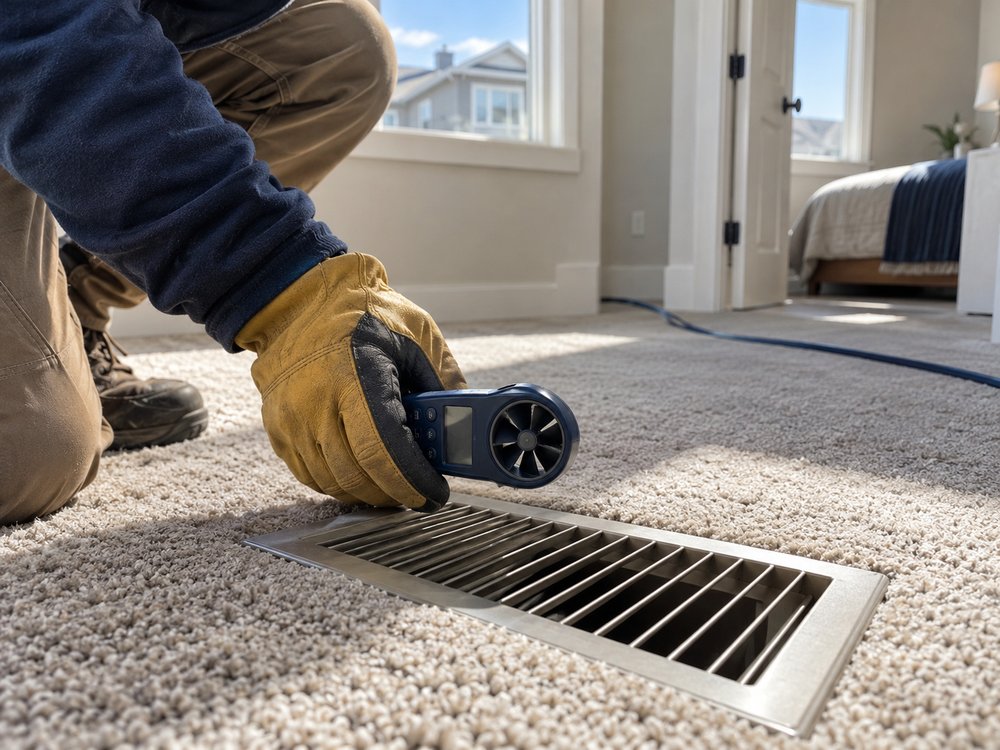
What the existing ducts can carry
Measured, not assumed. If the duct system cannot carry the air the new equipment needs, better equipment makes the house worse, and that goes in the quote either way rather than being discovered afterwards.
The flue and the electrical supply
Going to a high-efficiency appliance changes the venting completely, and on a flue shared with a water heater it changes that too. The electrical requirement is read off the plate of the proposed unit and compared with the circuit that is actually there.
One page
Model numbers, capacities, what is being removed, what is being altered, and the price. Plus the commissioning figures afterwards, which is the part almost nobody hands over.